
The Agile Product Owner: Role, Responsibilities, and the E-Commerce Operating Model
Understand what an agile product owner is accountable for and how an agile e-commerce team is organised, from the eight functions to the metrics that steer it.
A distribution strategy decides where you sell. It says nothing about how the operation behind it is organised. That is the job of the operating model, and its pivot is one role: the agile product owner.
01Why the operating model matters
A distribution strategy names the channels a company sells through. It says nothing about how that company has to be organised to actually run them. That gap is the operating model: the organisation, the roles and the metrics that turn a distribution strategy into a running business.
Here is the break we see most often. The strategy is well reasoned. The organisation behind it is still the old one. Functional silos, long decision paths, reporting that looks backward instead of steering forward. A digital business runs on different physics. It needs an organisation that decides fast and roles that concentrate accountability instead of smearing it across three departments.
A good strategy on an old organisation fails on the decision paths, not on the idea.
02What does an agile product owner do?
An agile product owner owns a product or a value stream from idea to delivery. They coordinate the backlog, set priorities, and make the call on what gets built next and what does not. They sit between the business and delivery. Not the boss of the team, but the person who holds the course.
The product owner is the pivotal role in the shift from a classic to an agile organisation. In the classic setup the hierarchy decides and the team executes. In the agile setup the product owner carries content accountability and the team self-organises around it. That shortens decision paths, and it changes who is answerable when a number moves. If you are still deciding whether agile even fits your situation, start with the agile suitability filter.
03What are the responsibilities of a product owner?
The responsibilities of a product owner concentrate on one thing: deciding what the team builds and in what order. They own the backlog, translate business intent into deliverable work, and defend the priorities when everyone wants their feature first.
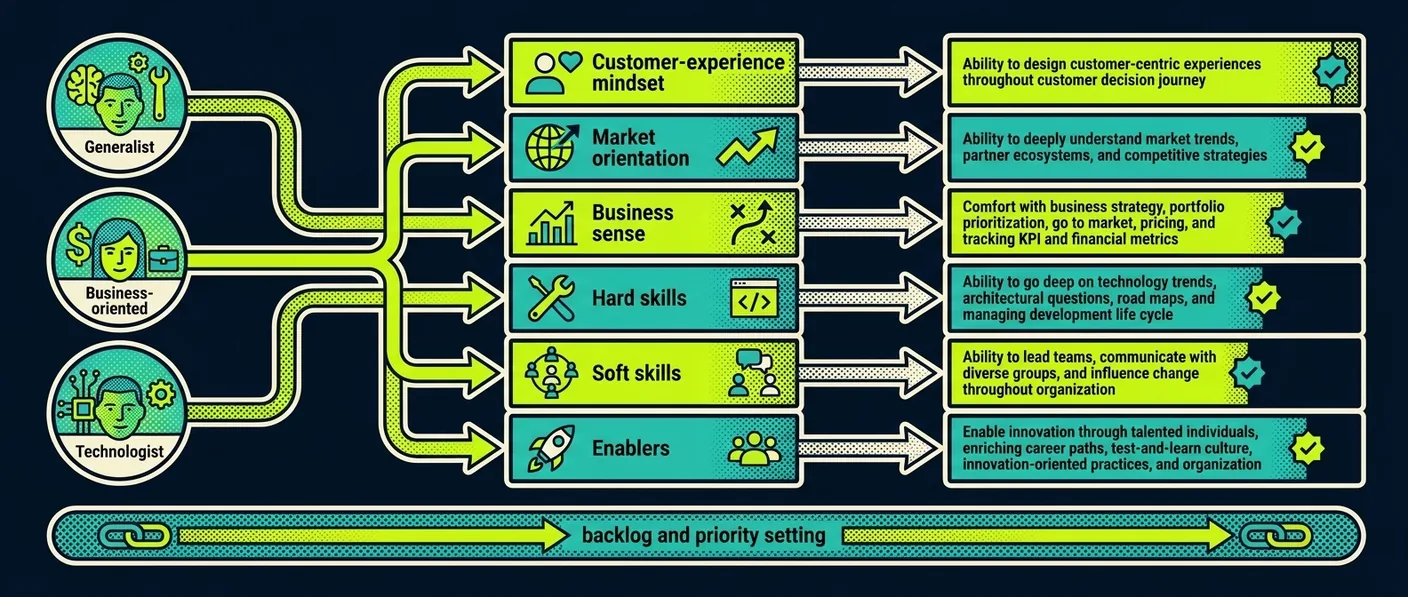
Across every kind of product the same skills carry the role. Designing customer-centric experiences across the whole decision journey. Reading the market and the competition. Business sense for prioritisation and metrics. Enough technical grasp to argue about architecture and development cycles without hand-waving. And the ability to lead a team that does not report to them, then carry change through an organisation that would rather not move.
04What are the product owner archetypes?
There is no single product owner archetype. In practice we see three, and they differ by background and focus.
- 01The generalist: broadly capable, mediates between technology and business, strong on products with many interfaces.
- 02The business-oriented: comes from the commercial side, optimises for specific business metrics, strong on B2C products with a clear revenue link.
- 03The technologist: deeply technical, focused on the platform, suited to complex back-end or B2B products.
No archetype beats the others. The only useful question is which one fits the product. A data-driven commerce product calls for a different owner than a technical integration platform. Match the person to the problem, not to a job title you copied from another company.
05How do you organise an e-commerce team for agility?
You organise an e-commerce team for agility by bundling functions around value streams instead of parking them in separate departments. An e-commerce operation is built from eight functions that together cover the whole customer lifecycle.
- 01Customer acquisition: SEO, SEA, display, affiliate, social, messaging.
- 02Customer experience: interfaces and conversion-rate optimisation.
- 03Orders and payment: order management, payment, risk and fraud.
- 04Customer retention: CRM, loyalty programmes, chat advisory.
- 05Customer service: chatbot and in-person.
- 06Buying and merchandising: planning and on-site merchandising.
- 07Data and analytics: web analytics, reporting.
- 08Supply chain: inventory, warehouse, transport, shipping.
In the classic organisation these functions sit in separate departments with their own reporting lines. That builds silos. Acquisition optimises its numbers, customer experience optimises its own, and nobody steers the whole flow. In the agile organisation the same functions are bundled around value streams, each with a product owner who sets the priorities. Departments become teams. Direction becomes self-organisation.
06How do you measure success, from OKRs to operational KPIs?
An agile operating model needs a metrics system that connects the strategy to the daily work, and it runs on three levels. Reporting at the top, OKRs in the middle, operational KPIs at the bottom. Each level answers to the one above it.
The operational level breaks revenue down into its drivers. Revenue is the product of average order value and the number of orders. Average order value depends on the average selling price and the units per transaction. Orders depend on the conversion rate and the number of visitors. Whoever knows this chain knows where to turn when they need to move revenue, and can hand accountability for each lever to a team with a product owner. We go deeper on the metrics themselves in our work on e-commerce KPIs.
07What we have seen in practice
We have built and supported this operating model in corporate-development work, in B2C fashion e-commerce as much as in B2B. The pattern holds either way. Bundle functions around value streams, concentrate accountability in product-owner roles, and build a metrics system that runs unbroken from strategy to daily steering.
Distribution decides where you sell. The operating model decides how the operation is organised. The two belong together, and the product owner is the joint that holds them.