
Merchandise planning, mapped from finance to four sales channels
The premium fashion operating chain runs the same way in every house. Six lanes, one flow, and a loop back to finance that most people forget to draw.
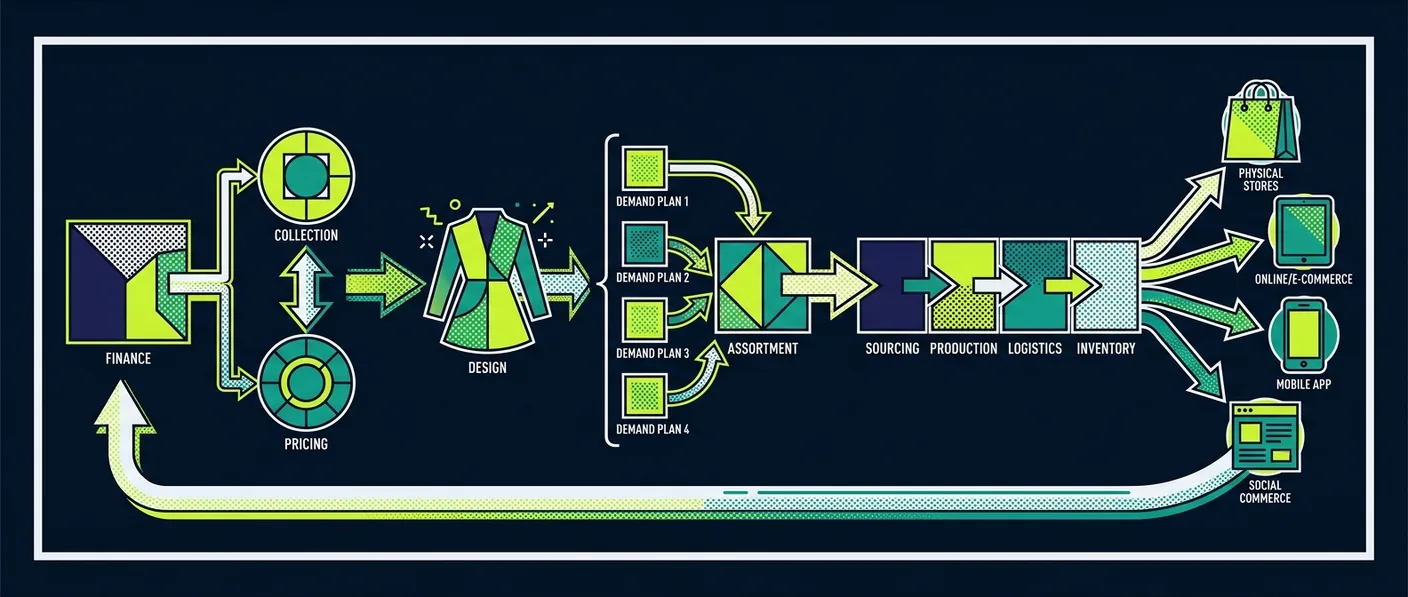
Every premium fashion company runs the same chain. A financial plan becomes a collection, the collection becomes a buying budget, the budget becomes an assortment, the assortment becomes demand, demand becomes supply, and supply becomes units standing in four different sales channels. Six lanes, one flow, and a loop back to finance that most people forget to draw.
We have built and audited this chain from inside corporate development. What follows is the model as it actually runs, lane by lane: what each lane decides, and what it hands to the next one. If you own merchandise planning and you have ever wondered why a decision three lanes upstream broke your assortment, this is the map.
01What does finance actually decide?
Finance decides two things that leave this lane: the financial plan and the financial KPIs. Both re-enter the chain later, which is why finance both opens the flow and closes it.
The plan does not simply sit at the top as an envelope. It enters the chain twice, once into target pricing, and once directly into the channel demand plans further downstream. That second entry is the one people miss. Finance is not only setting the size of the business. It is constraining what each individual channel is allowed to plan for before buying has said a word.
The KPIs run parallel and feed the marketing plan and the terms and conditions at the far end. So the same lane that opens the chain also sets the rules that close it.
Hands forward: the pricing envelope, and a per-channel constraint on demand.
02Why do collection and pricing argue?
Collection definition and target pricing are the only two nodes in the entire chain that negotiate. They are connected in both directions, and they settle together or the season starts wrong.
Everywhere else in the model, information moves one way: a lane decides, hands forward, and does not hear back. Here, the collection shapes what price architecture is credible, and the price architecture shapes what the collection can contain. This is the single bidirectional edge in the flow, and it is worth knowing exactly where it sits.
The collection and the price architecture settle together, or the season starts wrong.
The marketing plan sits alongside, drawing from financial KPIs rather than from the collection. Marketing is planned against the numbers, not against the product.
Hands forward: a settled collection with a price architecture attached.
03What happens between design and buying?
Product design and sampling are the shortest lane in the model, and the easiest to treat as a black box from outside. The structurally interesting part is that design hands forward to two places at once.
Design does not only feed sampling. It also runs a long connector straight into the open-to-buy plan. The buying budget is being shaped by design decisions before samples exist. If you have ever seen a budget defended on the basis of a collection nobody has physically held yet, this is the edge that made it possible.
Hands forward: a buyable product definition, and an early input into the buying budget.
04What is open to buy planning, and what does merchandise planning decide?
Open to buy is the budget lane, and merchandise planning is where four channel demand plans, one assortment plan and a markdown plan converge. This is where the chain gets dense, and it is where most operational pain originates.
Four things happen here. The open-to-buy plan sets the budget. Four separate channel demand plans each plan their own requirement independently. The assortment plan pulls from both the budget and those four channel plans. And the promotion or markdown plan sits alongside.
What do DOS, IRT, OUT and WHS mean?
DOS, IRT, OUT and WHS are SAP distribution channel codes, three-digit abbreviations that appear in the channel field of the system itself. They are not industry slang, and reading them correctly changes how you read the whole model.
- DOSDirectly operated stores, the brand's own physical retail.
- IRTInternet retail, the brand's own direct online business.
- OUTDirectly operated outlets, the brand's own clearance retail.
- WHSWholesale, the brand's wholesale business selling to department stores and multi-brand retailers under wholesale conditions.
A fifth code, LIZ, covers licensees, where a licence partner manufactures and sells under the brand name and the brand collects a royalty. It sits outside the goods flow entirely, because the brand never owns the unit, which is why the target model works with four.
Here is the part that gets misread. All of these are the brand’s own business. That is why they live as distribution channels inside one system: in SAP the distribution channel is one dimension of the sales area, alongside sales organisation and division. It describes how the brand sells, not who else sells. Wholesale is not somebody else’s business, it is the brand’s business conducted on wholesale terms.
What separates them is the customer and the conditions. DOS, IRT and OUT sell to the end consumer at retail conditions, and the brand keeps the retail margin and the customer relationship. WHS sells to a retail partner at wholesale conditions, so the margin is thinner and the partner owns the consumer. LIZ sells nothing at all and collects a royalty.
Do not read licensing as the small one. It is how a fashion house participates in categories it does not manufacture. Fragrance, eyewear and watches are typically made and sold by licence partners under long-term agreements, often running a decade or more. Beauty alone is roughly a fifth of the personal luxury goods market and almost no fashion house makes it. The royalty channel is how they are in that market at all, and it is the reason licence income shows up in the same conversation as the price tier a house occupies.
Inside the three consumer-facing channels there is a second split. DOS and IRT sell at full price. OUT is where price comes down. So the brand owns the channel its own markdown lands in.
That is the setup for the observation that changes how you read the whole model: markdown is planned as an input, not as a reaction. The assortment plan and the markdown plan both converge into total demand. In the target model markdown is a planned quantity that shapes what supply chain is asked to deliver, before a single unit has been sold. And it can be planned that way precisely because the brand controls the outlet channel it will land in. Most companies still run markdown as a recovery instrument. The model treats it as a planning instrument, and the two behave very differently on margin.
Hands forward: total demand, one number carrying four channels’ requirements and a planned markdown position.
05How does supply chain turn demand into allocated stock?
Supply chain turns total demand into committed units by sourcing, planning material, receiving goods and allocating stock across the four channels. Total demand meets sourcing, and both feed material requirements planning.
Sourcing here covers own production, cut and make, and finished goods purchasing. MRP, material requirement planning, converts the demand into purchase contracts and production orders. Inbound delivery monitoring tracks what is coming. Goods receipt and inventory records what arrived.
Then allocation. The four channels reappear. The same DOS, IRT, OUT and WHS that planned demand two lanes ago now become buckets in advanced available-to-promise, the aATP layer, competing for the units that physically exist. Outbound supply assignment settles who gets what.
Look closely at what that competition is. Every bidder is the brand’s own business. Allocation is not a negotiation with outside parties, it is the brand deciding which of its own channels to feed first. And because the same unit earns retail margin in DOS and wholesale margin in WHS, every allocation decision is a margin decision wearing a logistics costume.
The system is called available-to-promise. Almost every implementation builds the availability and skips the promise.
Hands forward: outbound supply assignment. Units, committed, per channel.
Six lanes, every node, the allocation group and the loop back to finance. Opens full size in a new tab.
Open the operating model06Where does the chain end, and where does it start again?
The chain ends at four sales channels and a conditions layer, then loops back to finance to plan the next season. The four channels appear here for the third time, now as actual sales channels rather than plans or buckets.
That triple appearance is the single most useful thing in this model. The same four codes mean three different things depending on which lane you are standing in: a demand plan in buying, an allocation bucket in supply chain, a sales channel at the end. When planning and fulfilment disagree about the same units, this is usually where the confusion started, with two lanes using identical labels for non-identical objects.
Draw it as a straight line and you have described a project. Draw it as a loop and you have described an operating model.
Alongside the channels sits a rule-based terms and conditions layer: returns, invoicing, contracts, conditions. This is where the wholesale conditions actually live, which is why the layer is rule-based rather than negotiated per order.
And from there a connector runs back along the bottom of the whole diagram into finance. That return path is the part almost every write-up drops. What the sales channels and the conditions layer produce becomes the financial reality that plans the next season.
Hands forward: the financial reality that plans the next season.
07What this means if you own any part of it
Three practical consequences follow from reading the chain as a flow rather than a set of boxes.
Nothing in this chain is a quick win. In the prioritisation work we have done on order management, every high-impact lever also carried high effort, because the levers that matter sit in the core, in planning and allocation, and everything cheaper is downstream of a decision the core already made. The empty quadrant is empty for a structural reason.
Second: a lane can only be as good as what it was handed. Assortment planning failures are frequently pricing settlements. Allocation failures are frequently demand plan failures.
Third: the loop is where the model earns its name. Systems that plan the chain and systems that fulfil it have to agree about the same units, or the disagreement surfaces as a service problem and gets fixed as a service problem, which never works.
If you are mapping this chain in your own business, or arguing about where SAP, PLM and planning tooling should meet it, that is the work we do. Thirty minutes, and we will sketch where your flow breaks.