

Digital Trade Marketing: turning shop findings into joint improvement levers
Most brands already know what is wrong with their partners' shops. What is missing is a form in which the diagnosis becomes joint work. That form is an action catalog.
Most brand manufacturers know what is wrong with their retail partners' websites. Thin product pages, a shop search that cannot find their own brand, a checkout that loses purchases. Rarely is the diagnosis what is missing. What is missing is a form in which the diagnosis becomes joint work.
That form is an action catalog. A set of concrete, named packages that you offer your retail partners, each with a defined benefit for the partner, clear ownership, a realistic timeline and a target figure. Not a consulting report that ages in the partner’s inbox. An offer from which a partnership grows in implementation steps.
What is missing is rarely the diagnosis. What is missing is a form in which the diagnosis becomes joint work.
01What does trade marketing mean today?
Trade marketing is the brand’s support of sell-through at the retail partner, and today that support is decided inside the partner’s shop. It long meant advertising subsidies, secondary placements, displays at the shelf. That core remains. What has shifted is where it is decided. Customers check, compare and buy in the partner’s shop, and that is where it is settled whether the joint work holds.
Digital trade marketing therefore means making the excellence of the partner’s shop a joint task. That sounds big and is in fact craftsmanship. Because a good online presence consists of the same ingredients, at every retailer.
02What are the ingredients of partner-shop excellence?
Partner-shop excellence is six ingredients working together, and none of them is new. What is new is treating them as a joint task of brand and retailer, with named actions instead of general appeals.
- 01Technology. A fast, crawlable shop with structured data for prices, reviews and images.
- 02Content. Product copy that gets found and sells, instead of manufacturer data in raw format.
- 03Media. Product images and videos at marketplace level, the way customers know them from the big platforms.
- 04Availability. Stock and delivery signals visible in the shop, because nothing converts worse than uncertainty.
- 05Visibility. Search, ads and social played so that the brand is found at the partner.
- 06Price. A consistent price position across channels, within what is legally permissible.
03Which action packages belong in the catalog?
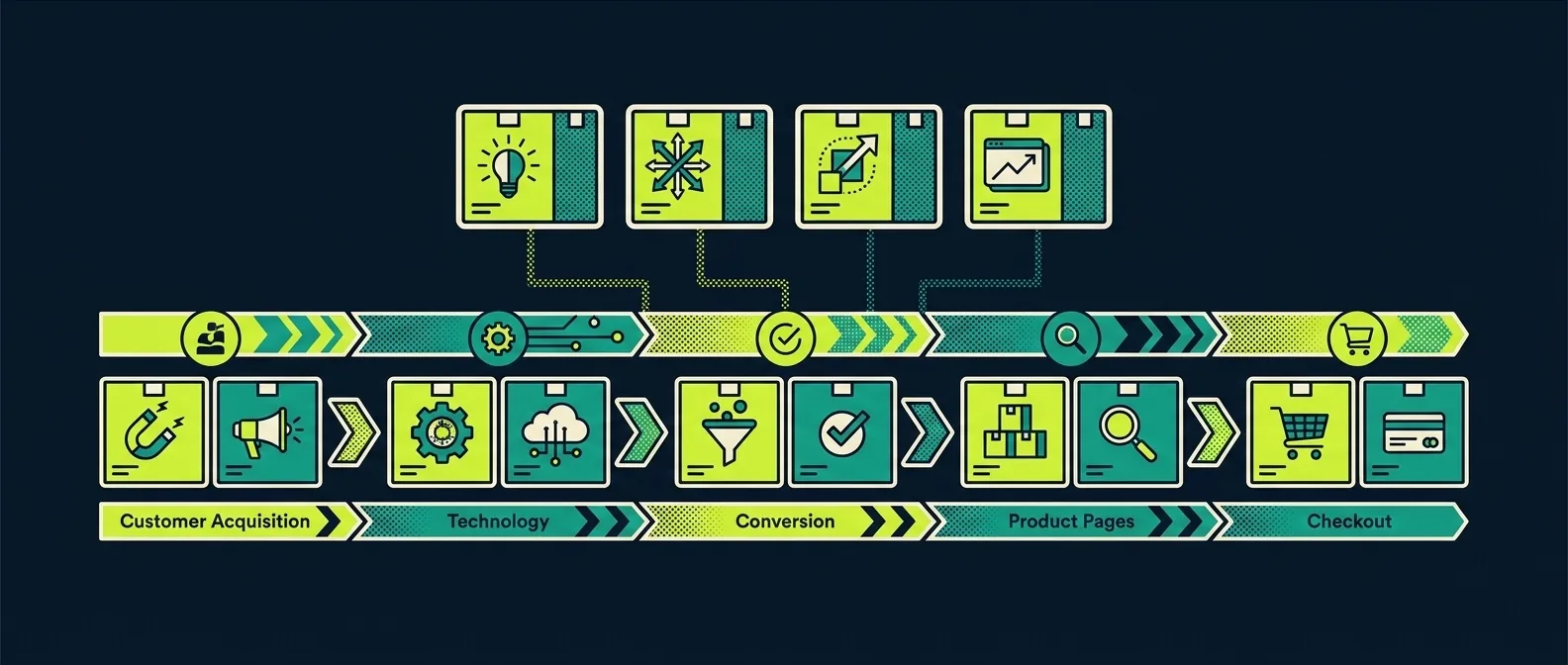
The action catalog follows the journey of the partner’s shop, from the first search to the completed purchase. Every package carries a name, so both sides know what they are talking about.
The first package is always the outside check of the partner’s shop, along the path a customer takes. Complemented by the view only the brand can contribute: the partner’s traffic mix by source, their visibility in search and how they stand in it against their own competitors. This finding prioritizes the catalog. Which metric counts per package is something we settle along the e-commerce KPIs that are relevant for your portfolio anyway.
04What turns recommendations into a program?
Two execution rules turn recommendations into a program, and both concern how the work runs rather than which actions get selected. Targeted digital recommendations are what every audit delivers. They become a program through these rules.
- 01An action is completed and its effect shown before the next one starts. The partner experiences the benefit before carrying the next effort.
- 02Follow-up is a fixed part of every action, with dates for implementation status, support needs and the result metric.
The first rule builds trust in steps that no framework agreement can produce. The second keeps the program operational: recommendations without follow-up discipline remain a report.
Add to this an observation from practice. The catalog gets stronger when it is tailored per key partner. The same building blocks, but selected and prioritized by what the findings at the individual partner support. In this form, the packages are nothing other than the activity list of a Joint Business Plan.
05What has been added since the classic catalog?
Four developments belong in every action catalog today: where-to-buy, price monitoring, retail media, and connectivity for AI assistants. The package logic stays stable. The package list does not.
Where-to-buy. The brand collects purchase intent on its own website and passes it to partners: availability per partner, a direct jump into their shop or store. For the partner that is qualified traffic, for the brand it is visibility into where demand flows. As a package this means the partner’s where-to-buy integration, including the agreement on which data flows back.
Price monitoring. Prices across partners and marketplaces can be observed continuously today, with tools like Price2Spy. Price anomalies, availability gaps and gray-market signals become visible before they mature into conflict at the annual review. As a package this means a shared picture of the price position per assortment area and an agreed way of handling deviations, within what is legally permissible.
Retail media. Ad placements at the retail partner have become a business of their own, with sponsored placements, display inventory and data offerings. A contemporary catalog treats retail media as a package family: which formats the partner offers, what they deliver, which metrics per format count as proof of effect, and how the investment compares against other actions. Without this baseline, retail media is a cost block without proof of effect.
Connectivity for AI assistants. Purchase decisions increasingly run through AI assistants that search, compare and recommend products. What these assistants reliably read is clean structured data and well-maintained product information. That remains the resilient foundation and is part of the technical packages. Added to this, llms.txt is a young standard with which a shop declares its most important content machine-readably. Its reach effect is unproven today, the cost is minimal, and whoever is cleanly readable early has nothing to catch up on later. We recommend llms.txt as what it is: cheap provision, not a miracle cure.
The real shift meanwhile goes further. Assistants are completing purchases directly. Open protocols like the Universal Commerce Protocol and the Agentic Commerce Protocol, carried by the major platforms, make shops connectable for buying agents, up to and including payment inside the assistant itself. As a package this means checking and establishing the partner shop’s connectivity, from complete product-data feeds through current availability and price interfaces to the question of whether their shop platform already supports the protocols.
The channel is young, but it is live. The partners who are connectable early appear where the others do not.
06What does the catalog achieve strategically?
Strategically, an action catalog changes the brand’s role at the partner. The supplier who negotiates terms and demands shelf space becomes the partner who measurably contributes to the retailer’s business. In the annual review that is worth more than any argument. And it is the basis on which the brand’s own concerns become negotiable too, from data access to brand presence.
07How do you start?
The start is always the same: the check from outside. If today you send your retail partners findings instead of offering actions, a short conversation is worth it. We sketch with you what an action catalog looks like for your partner portfolio and which packages to start with at your most important partner.
Everything else falls into place after that first check.